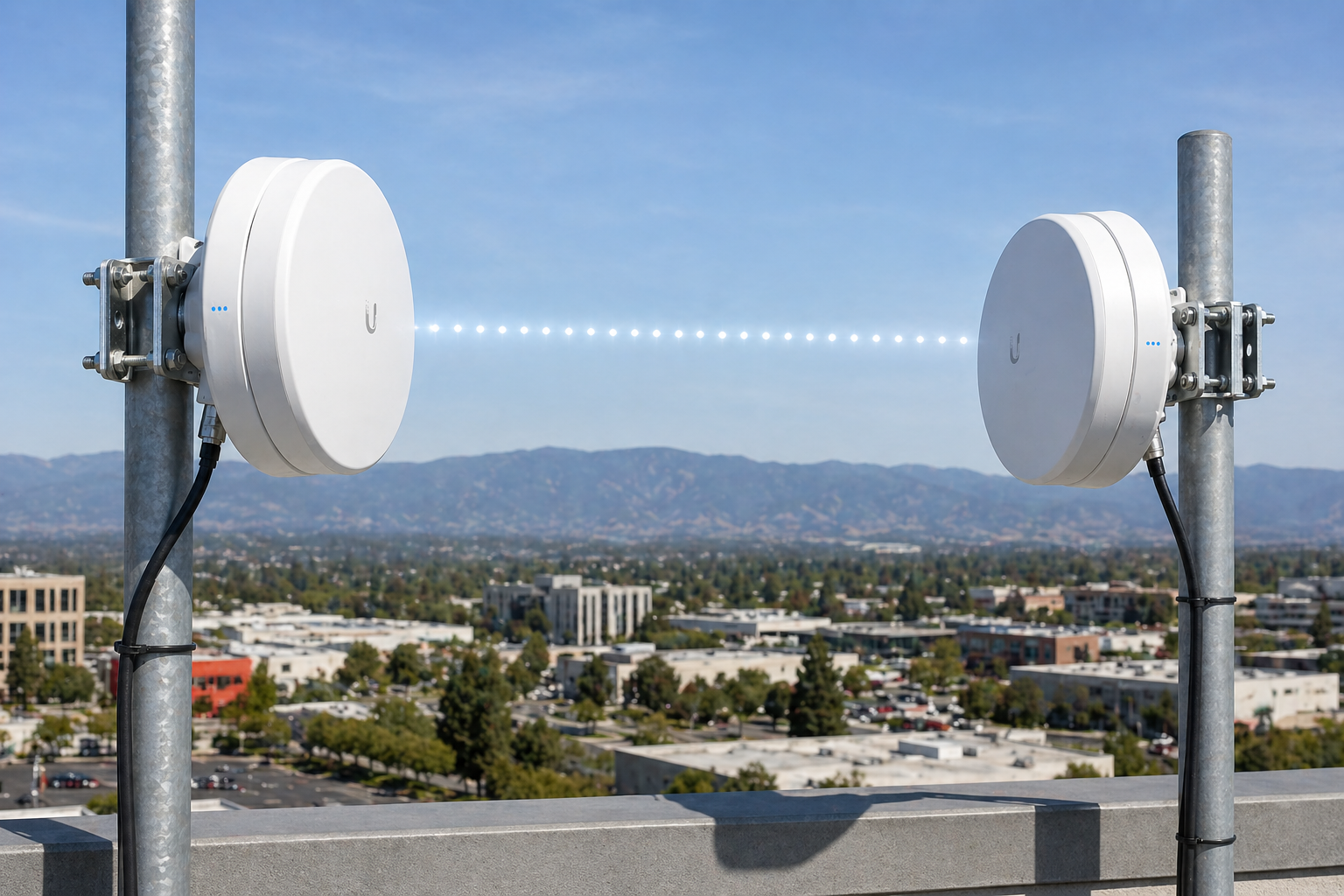
Point-to-Point Networking in Redding, CA
Point-to-point networking is a reliable way to extend network connectivity between two locations without trenching cable over long distances. In Redding, this is especially useful for remote buildings, shop structures, construction sites, gate systems, storage yards, camera poles, ranch properties, and other locations where traditional wiring is expensive, disruptive, or simply not practical.
At AAX Alarm, we design and install point-to-point wireless bridge systems that create a dedicated network link between separate locations. When properly planned, aligned, and configured, these systems can deliver stable connectivity for surveillance cameras, internet access, access control, VoIP, automation systems, and general network traffic across large properties and remote areas.
What Is Point-to-Point Networking?
A point-to-point network link uses two wireless radios to create a direct connection between one physical location and another. Instead of running copper or fiber underground, the network is transmitted wirelessly from one endpoint to the other. In simple terms, it acts like a long-distance network bridge, allowing you to extend your LAN or internet connection to a remote location.
This type of system is commonly used when two buildings need to share the same network, when a remote camera location needs backhaul to the main recorder, or when a gate, barn, warehouse, office, or job trailer needs data service but is too far away for an economical cable run.
Why Point-to-Point Networking Works So Well for Remote Locations
Remote locations create a real infrastructure problem. They need connectivity, but they are often too far from the main building, separated by asphalt or concrete, blocked by terrain, or located in areas where trenching would be costly and time-consuming. A properly engineered point-to-point link solves that by delivering network access across distance without the labor and disruption of major underground work.
In and around Redding, many properties are spread out, rural, or built in ways that make wiring difficult. Detached buildings, perimeter gates, equipment yards, outlying structures, and long drive approaches are all common here. Point-to-point networking allows those areas to be brought onto the network so they can support security cameras, access control, remote monitoring, and internet-connected devices.
Key Technical Advantages
One of the main advantages of point-to-point networking is efficiency. Instead of paying for trenching, conduit, pull boxes, cable protection, and labor over long distances, a wireless bridge can often provide a much faster path to deployment. When there is clear line of sight and the system is properly installed, point-to-point equipment can provide low-latency, high-throughput communication suitable for many business and security applications.
These systems are also scalable. A business may start by linking one remote building, then later expand to support more cameras, more devices, or additional remote structures. With the right hardware and design, a point-to-point link can become a core part of the property's communications infrastructure.
- Eliminates long trench runs across dirt, asphalt, concrete, and developed property
- Extends network connectivity to remote buildings and equipment areas
- Supports IP cameras, NVR traffic, access control, and general data
- Reduces installation time compared to major underground cabling projects
- Provides strong performance when line of sight and signal path are properly planned
- Allows centralized management of systems in outlying areas
Important Design Factors
Not every wireless link is the same. Good point-to-point performance depends on more than simply mounting two radios and hoping for the best. Proper system design includes line-of-sight verification, mounting height, beam alignment, environmental conditions, distance, interference levels, and expected bandwidth demand. In many cases, the Fresnel zone also needs to be considered, especially on longer links where trees, structures, or terrain may partially obstruct the signal path even when the endpoints appear visually clear.
Hardware selection matters as well. Radio frequency, antenna design, channel width, power levels, and throughput expectations all affect link quality. A link carrying several high-resolution security cameras has different design requirements than a simple gate controller or small remote office connection. That is why proper planning is critical if long-term reliability matters.
How It Helps Security and Surveillance Systems
Point-to-point networking is especially valuable for security applications. Some of the most important camera views are often the hardest ones to wire: front gates, fence lines, remote parking areas, equipment yards, detached shops, construction entrances, and outer buildings. A point-to-point bridge can carry that video traffic back to the main network, recorder, or monitoring system without requiring an expensive cable path across the property.
This also makes remote expansion more practical. Instead of limiting surveillance to the main building, you can place cameras where they actually provide useful coverage. That improves visibility, verification, deterrence, and response time, especially on larger sites in Redding where the property layout may leave major gaps if everything has to be wired the traditional way.
Common Uses for Point-to-Point Networking in Redding
Point-to-point links are commonly used to connect detached offices, barns, warehouses, construction trailers, storage buildings, gate controllers, remote camera towers, pump houses, agricultural structures, and outbuildings. They are also useful for businesses that need to extend internet or surveillance coverage across a large parcel without the cost of fiber or copper installation between every location.
In Redding and surrounding areas, these systems are a smart fit for commercial properties, industrial yards, rural homes, ranches, shops, and job sites where distance and layout make standard cabling difficult. When designed correctly, point-to-point networking provides a practical solution for connecting infrastructure that would otherwise remain isolated.
Why Businesses Choose Point-to-Point Instead of Trenching
Trenching is often the biggest barrier to expanding a network. It can require permits, added labor, restoration work, conduit, directional boring, and significant disruption to the site. Wireless bridging can often bypass much of that cost while still giving the customer the connectivity needed for cameras, internet access, gates, and remote devices. For many properties, that makes point-to-point networking the most cost-effective path forward.
It also gives customers flexibility. A site can be expanded in stages, temporary locations can be connected faster, and remote infrastructure can be added without turning every project into a major underground construction job.
Professional Point-to-Point Networking Installation in Redding
At AAX Alarm, we install point-to-point networking systems in Redding for customers who need dependable connectivity in remote locations. We understand that real-world performance depends on proper design, proper mounting, correct alignment, and hardware that matches the application. Whether the goal is to support cameras, connect a separate building, extend internet service, or bring a gate or remote device online, we build systems with real-world function in mind.
If you have a remote location that needs data, cameras, or network access, point-to-point networking may be the right solution. Contact AAX Alarm to discuss a point-to-point networking installation in Redding and see how a wireless bridge can help connect your property more efficiently.
Get a Quote